
Criminal Court Cases in Marshall County
Iowa has one unified District Court rather than separate county criminal courts for different offense levels. Marshall County felony and indictable misdemeanor cases are prosecuted by the County Attorney and heard within Iowa Judicial District 2B. Magistrate and associate district functions handle initial appearances and lower-level matters inside that same system. A filed city ordinance or simple-misdemeanor matter can also produce an Iowa court record.
The Marshall County Clerk of District Court is the court-file custodian. Its office is at 17 E. Main Street, Marshalltown, IA 50158, and the published contact number is 641-754-1603. The sheriff is not the keeper of pleadings, judgments, or certified court dispositions. A sheriff booking file may identify the first alleged charge, but the clerk’s case shows what prosecutors filed and what the court ultimately did.
Marshall County District Court Records Desk
The clerk provides the fallback when a Marshall County case or document is not available from home. Iowa court guidance distinguishes anonymous basic access from subscriber tools and public-terminal links. The clerk can explain how to inspect a public file, request a plain or certified copy, or locate an older record held on paper, microfiche, or in a digital archive. Confirm current hours, document availability, and fees before a trip.
Marshall County Clerk of District Court
17 E. Main Street
Marshalltown, IA 50158
641-754-1603
Marshall County Attorney
1 E. Main Street
Marshalltown, IA 50158
641-754-6314
Weekdays, 8:00 a.m.-4:30 p.m.
Historical Judicial Branch guidance listed ordinary copies at $0.50 per page, with possible added service costs. The research did not confirm that as a current 2026 charge, so ask the clerk for an estimate.
Marshall County Case Record Searches
Iowa Courts Online is the main remote channel. Use Trial Court Case Search, then narrow the statewide result set to Marshall County. Correct spelling matters, and the official guide requires at least two surname letters for a name search. A known Case ID can be a better route than a common name.
- Open Trial Court Case Search and enter at least two letters in Last/Firm Name.
- Add the first name only when its spelling is known, or enter a known Iowa Case ID.
- Select Marshall in the County control and narrow by case type when useful.
- Open the Case ID and read every count, docket event, disposition, and judgment entry.
- Ask the clerk for a public-terminal view, archived record, or certified copy when needed.
| Field label | Type | Required | Format or use |
|---|---|---|---|
| Last/Firm Name | Text | Yes for name search | At least two letters; exact spelling; % wildcard supported |
| First Name | Text | No | Enter an initial without a period |
| Second name row | Text | No | Combine with AND or OR |
| County | Dropdown | No | Select Marshall to localize results |
| Case ID/Number | Text | Alternative | Use a known Iowa case number |
| Case Type | Dropdown | No | Narrow to the relevant criminal type |
| Advanced or Schedule Search | Tab | No | Registered subscription required |
Advanced and schedule searches require a registered subscription. A public terminal at the Marshall County clerk may expose document links unavailable through anonymous basic access.
Marshall County’s Two-Letter Search Rule
The portal requires at least two letters in the surname or firm-name field. The percent sign works as a contains wildcard, such as %dan, but a very broad pattern can flood the results with unrelated people. Filter to Marshall County and compare the case number, court, filing date, party role, and case type before deciding a record belongs to the person sought.
Two names can be joined with AND when both must appear in one case or OR when either name may appear. A first-name initial takes no period. The search result is an index, so open the Case ID and read the detail rather than treating a similar name as a match.
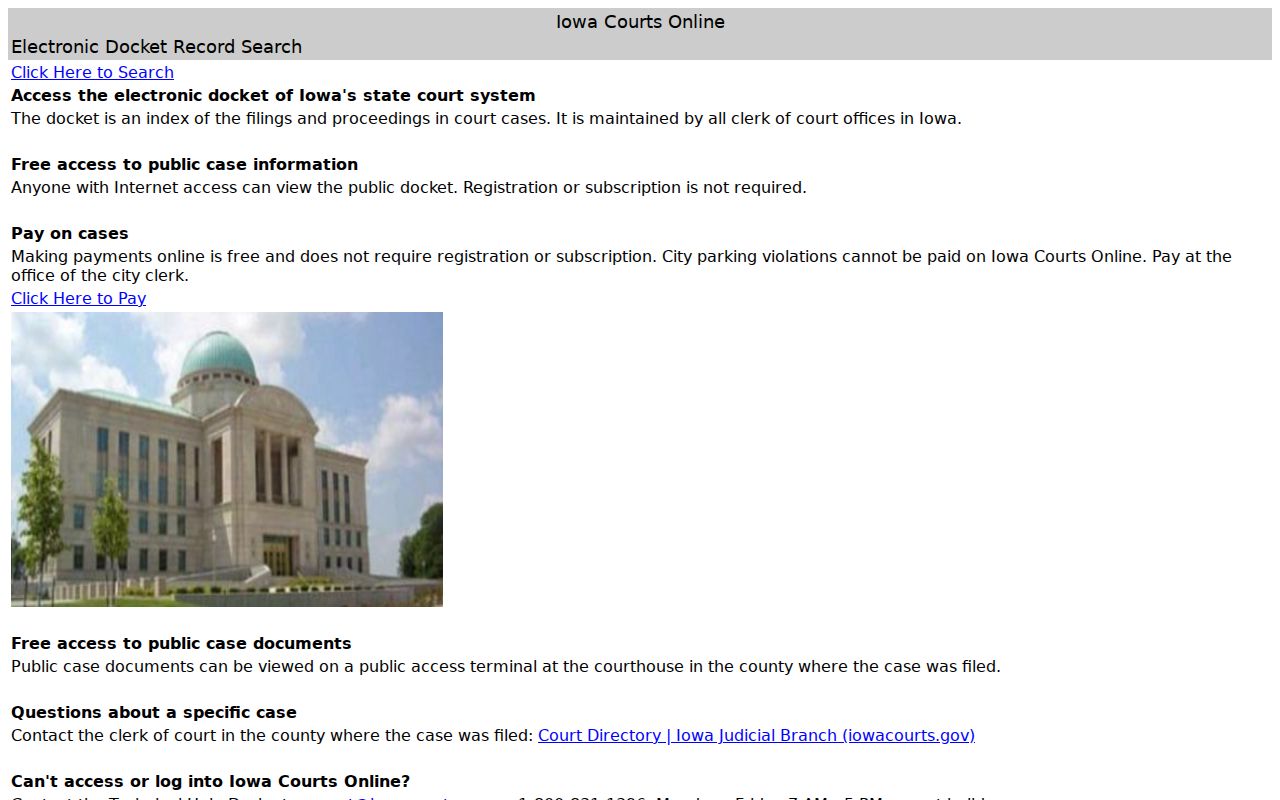
The official Iowa Courts Online interface supplies the live statewide search form.
Selecting Marshall County is one of the best ways to reduce identity errors in a common-name search.
What a Criminal Case File Contains
A Marshall County detail screen can identify the court, case type, filing date, status, parties, charges, hearings, money entries, and final action. Document links depend on public security level and the user’s access. The docket is chronological, while the disposition states the result. Both are needed because an entry marked disposed does not automatically mean convicted.
| Case Number & Court | The unique Iowa Case ID and the Marshall County court assignment. |
|---|---|
| Charging Document | The complaint, trial information, or indictment setting out filed allegations. |
| Counts | Each separately alleged offense, which can end differently from other counts. |
| Docket Entries | Dated filings, orders, notices, hearings, motions, and other case events. |
| Disposition & Judgment | The result for each count and the court’s formal adjudication. |
| Sentence & Conditions | Confinement, probation, financial entries, and related orders where public. |
Use the disposition and judgment for the result, not a scheduled hearing or the first allegation. Financial entries may show restitution, costs, or other court-ordered amounts.
Read Every Marshall County Case Count
A single Marshall County case can contain several counts. One may be dismissed, another amended, and a third resolved by plea or trial. The case status alone does not state what happened to each allegation. Read the charging event, count description, later amendments, plea, disposition, and judgment as a chain.
- Trial information
- An Iowa prosecutor’s formal charging instrument used in many indictable cases.
- Count
- One separately alleged offense within the case.
- Disposition
- The recorded result of a count or the case.
- Deferred judgment
- A judgment withheld while court-ordered conditions are completed.
- Judgment
- The court’s formal adjudication and resulting order.
An arresting officer’s first charge may differ from the County Attorney’s filed trial information. The court record, not the booking allegation, is the main source for the filed count and judicial result.
Criminal Case Stages in Marshall County
A criminal matter may begin with an arrest or citation, followed by a prompt initial appearance when custody requires it. A complaint starts the early court process. An indictable case can proceed through preliminary steps to a trial information or indictment, arraignment, discovery, motions, and a negotiated plea or trial. Judgment, sentence, postjudgment motions, and appeal may follow.
Case flow: Charges Filed › Arraignment › Pretrial › Plea or Trial › Disposition › Sentencing
A scheduled hearing is not an outcome. Check later docket entries and the disposition for each count. Very recent arrests may also appear in jail records before prosecutors file a Marshall County case.
Older Marshall County Court Files
Not every useful court record is a remotely viewable PDF. Iowa’s official guidance says clerks may keep older material on paper, microfiche, in digital stores, and in docket databases. A basic home user can see fewer links than a subscriber or a person using the clerk’s public terminal. Missing links can therefore reflect the access level or file format rather than the absence of a case.
Take the Case ID, party name, approximate year, and desired document to the clerk. State whether a plain copy is enough or a certified disposition is needed. Certification matters when a person asks DCI to correct an Iowa history entry. Ask about search, supervision, page, and certification charges before approving work, since current local prices were not confirmed.
Access Rules for Case Records
Most court records are public, but access is not absolute. Iowa court record controls restrict legally confidential cases and documents. Unserved arrest and search warrant cases remain confidential until service unless the court orders otherwise. Presentence reports, protected victim or witness material, private identifiers, many juvenile matters, and expunged records are also outside ordinary public view.
A private release does not override every juvenile protection. Remote redaction can also differ from the record available at a clerk terminal. When a known Marshall County case does not appear, ask the clerk whether spelling, age, format, security level, expungement, or archival storage explains the result. Do not rely on a missing public warrant entry as clearance.
Access point: Iowa Code chapter 22 supports public inspection, but court security rules and specific confidentiality laws govern what the clerk may release.
Marshall County Charges After Arrest
The County Attorney represents the State in Marshall County prosecutions. An officer’s arrest allegation starts the record trail, but the prosecutor decides which charges to file through the available Iowa charging process. That is why a booking label can differ from a later trial information. The clerk then records the filed counts and each later court action.
The Marshall County Attorney’s office is at 1 E. Main Street, with published weekday administrative hours. Its Fine Enforcement and Driver License Reinstatement Program addresses court debt and related compliance issues through stated payment-plan requirements. It is not an expungement program, and the County Attorney cannot give legal advice to private individuals.
For a broader view of how court, arrest, DCI, and custody records fit together, the Marshall County criminal history overview explains the separate custodians.