
Marshall County Criminal History Checks
Start with the question the record must answer. Iowa Courts Online is the first official stop for a filed Marshall County criminal case and its docket outcome. The Marshall County Sheriff handles deputy reports, jail bookings, and current county custody. Iowa DCI maintains the statewide fingerprint-supported repository. Each source covers a different part of the same event, so a name appearing in one system but not another is not proof of an error.
Prepare the full name, spelling variants, exact date of birth when using DCI, event date, city, agency, and any case, report, citation, or booking number. Then work from the most direct custodian outward.
- Search Iowa Courts Online and select Marshall County for filed cases.
- Call the jail for present custody or ask Sheriff Records for sheriff-created material.
- Contact the city police department when a city officer wrote the incident report.
- Order an Iowa DCI check when statewide releasable history is the question.
- Compare each count and disposition, then seek a certified clerk copy to resolve a mismatch.
Marshall County’s Three-Office Record Trail
Marshall County criminal records are split among distinct custodians. The Clerk of District Court at 17 E. Main Street keeps filed criminal cases, judgments, and certified dispositions. Sheriff Records and the jail share 2369 Jessup Avenue and handle deputy reports, booking questions, and custody verification. Marshalltown Police Records, at 909 S. 2nd Street, keeps reports made by city officers. DCI in Des Moines compiles qualifying fingerprint-backed Iowa history.
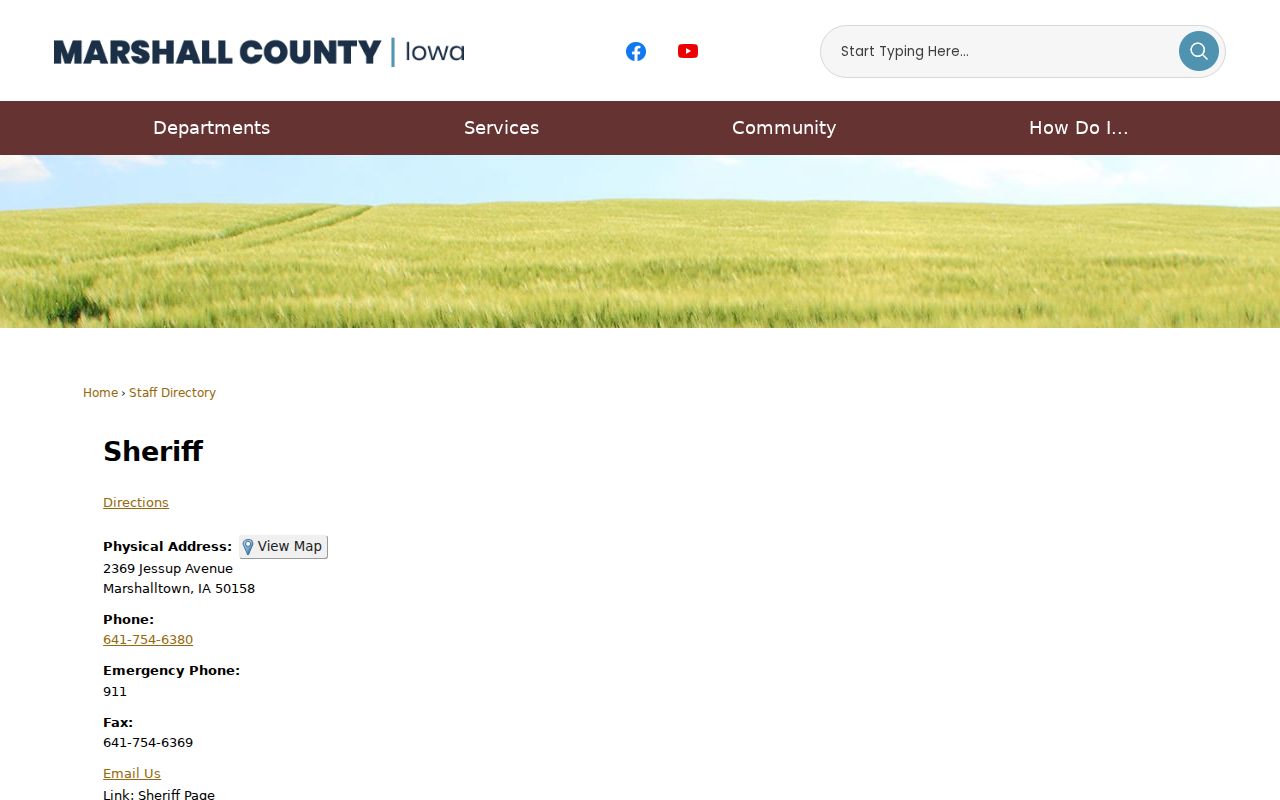
The Marshall County government directory shows the local department structure. Its layout helps explain why a request sent to the wrong building can stall even when the requested record is public.
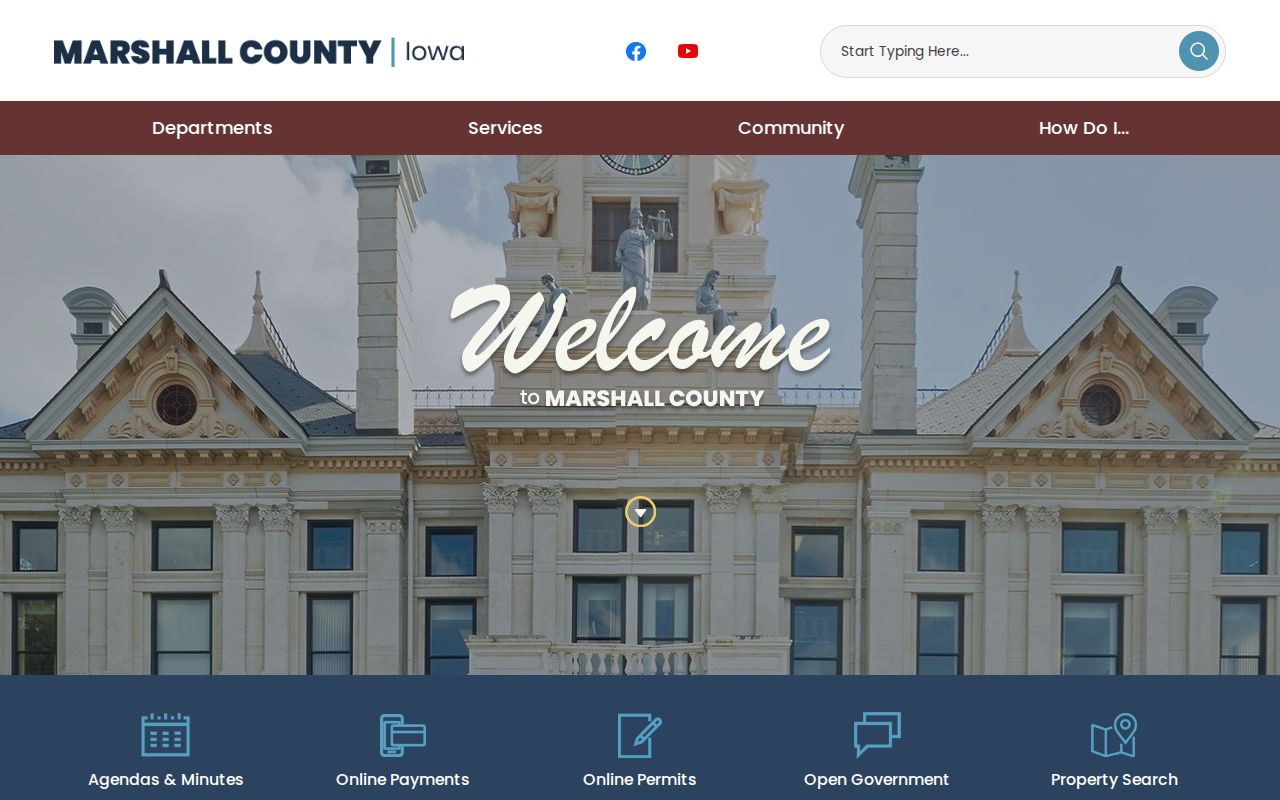
The directory is a routing tool, not a countywide criminal-history database. Match the record to the office before calling or writing.
| Question | First official channel | Fallback |
|---|---|---|
| How did a filed charge end? | Iowa Courts Online | Clerk of District Court |
| Is someone in the county jail? | Marshall County Jail | Written booking-record request |
| What did a deputy report? | Sheriff Records | Chapter 22 request |
| What statewide history is releasable? | Iowa DCI record check | DCI dispute process |
Official Background Checks in Iowa
The Iowa Department of Public Safety, Division of Criminal Investigation, runs the Iowa DCI Criminal History Record Check. Any requester may submit a first name, last name, and exact date of birth. The fee is $15 for each last name searched. Online requests need both the request and billing forms, and DCI also accepts mail, fax, email, and in-person submissions. Phone requests are not accepted.
Without a signed subject release, DCI withholds completed deferred judgments and arrests more than 18 months old when no final disposition is recorded. A release does not open confidential juvenile data. For an immediate in-person result, the subject must present government photo identification. DCI can return results by approved mail, fax, or email routes described on its current forms.
The official DCI request page shows the current submission choices.
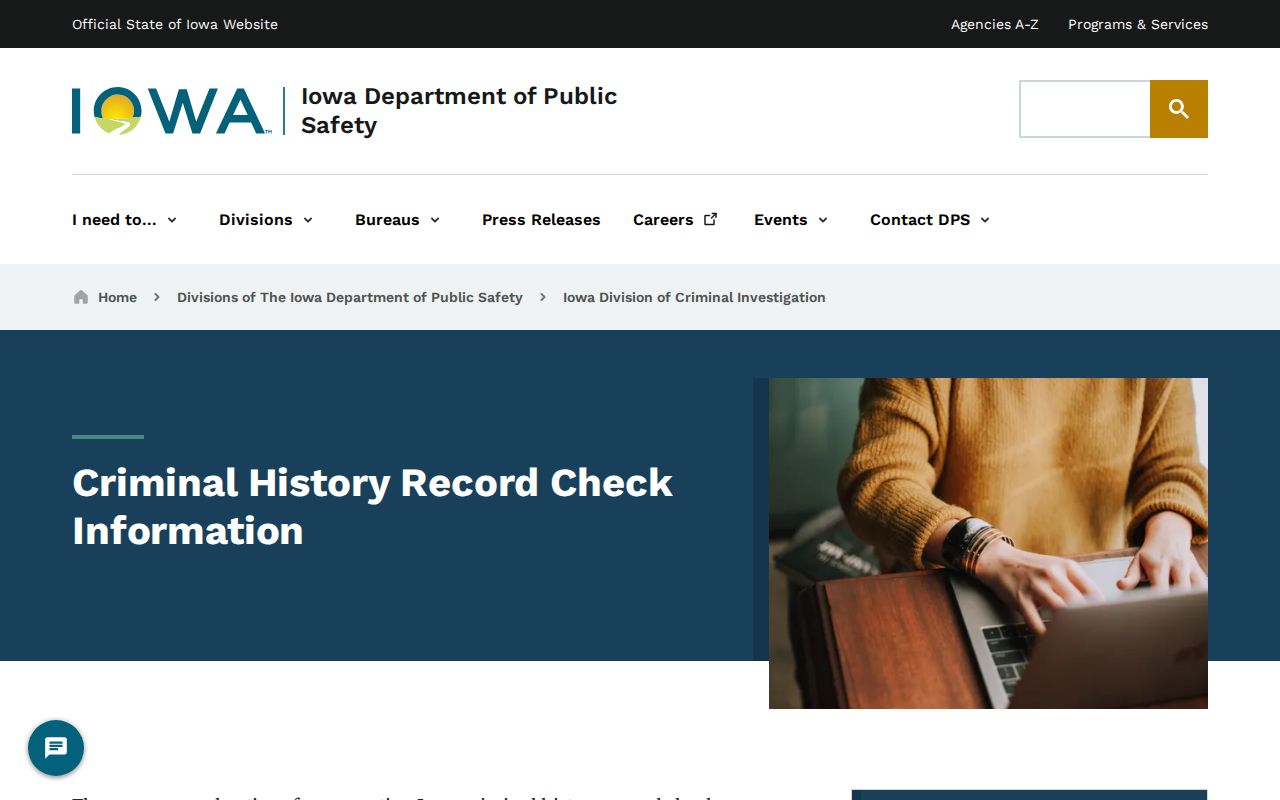
That state product answers a narrower question than a full Marshall County case search because reporting and release rules shape what DCI can return. For comparison, Iowa Courts Online uses these official fields:
| Iowa Courts field | Type | Use |
|---|---|---|
| Last/Firm Name | Text | Requires at least two letters; exact spelling; % wildcard works |
| First Name | Text | Optional; an initial is entered without a period |
| Second name row | Text | Optional; combine the names with AND or OR |
| County | Dropdown | Select Marshall to narrow statewide results |
| Case ID/Number | Text | Alternative search when the Iowa case number is known |
| Case Type | Dropdown | Optional filter for relevant criminal case types |
Fingerprints Link Marshall County Records
DCI states that an arrest must be fingerprinted and submitted before it can create a state criminal-history cycle. If fingerprints were not taken or transmitted, an arrest may exist in a Marshall County agency report, jail booking file, or court case while remaining absent from the DCI response. That gap is a reason to compare records, not to assume one office has lost the entire event.
The DCI Support Operations Bureau explains the central repository and identification function.
For a person’s own federal self-review, the fingerprint-backed route is the FBI Identity History Summary, not a local name-search product.
Kinds of Criminal Records
One incident may create several records at different times. The arresting agency writes the incident or arrest report. The jail makes a booking file after intake. The County Attorney decides which counts to file, and the clerk opens the court case. DCI may add a fingerprint-supported arrest cycle, while Iowa DOC creates custody or supervision records after a qualifying sentence.
- Incident and arrest reports: officer narratives, alleged conduct, and agency action.
- Booking records: intake, charge, bond, and custody data held by the jail.
- Court files: complaints, counts, docket events, orders, pleas, outcomes, and sentence.
- Warrant records: judicial orders whose public access can depend on service.
- Custody and registry records: DOC status or public chapter 692A information.
Arrest charge, filed count, and final disposition may differ. The court file is the key source for what was actually prosecuted and how each count ended.
Marshall County Custody Has Three Layers
Current local custody belongs to the Marshall County Jail. No official public county roster was found, so call 641-754-6380, visit the Jessup Avenue counter during posted administrative hours, or make a narrow written request for releasable booking information. A fresh arrest may not yet have a filed court case.
State prison, probation, and parole records use Iowa DOC Offender Search. Federal custody uses the Bureau of Prisons locator. Those systems do not replace the jail call. The Iowa Board of Parole provides the state parole authority’s official information.
Second Judicial District services administer Marshall County community supervision, while parole decisions belong to the Board of Parole.
Marshall County Criminal Records: What They Contain
The fields depend on the custodian. DCI emphasizes identity, fingerprint transaction data, eligible arrest cycles, court dispositions, and correctional movement. A Marshall County court file centers on the case number, filed counts, docket, judgment, sentence, and financial entries. A booking record centers on intake and current custody.
| Name & Identifiers | Legal name, aliases, date of birth, and identification numbers where law permits. |
|---|---|
| Arrest / Booking Data | Agency, date, alleged charge, booking time, bond, and custody status. |
| Charges & Statutes | Separate alleged counts and the Iowa provisions tied to each count. |
| Disposition | Dismissal, acquittal, plea, conviction, or other result for each count. |
| Sentence | Confinement, probation, conditions, restitution, costs, and related orders. |
| Custody / Supervision | Jail, prison, probation, parole, release, or published DOC status. |
Use the record’s own case, report, booking, or identification number when reconciling entries. A matching name alone is not enough to join records safely.
Marshall County Sheriff Is Not Court Clerk
The Marshall County Sheriff directory places Administration, Civil, Investigations, Patrol, Records, and Jail at 2369 Jessup Avenue. The main number is 641-754-6380, and published administrative hours are weekdays from 8:00 a.m. to 4:30 p.m. That office is the practical source for sheriff reports, booking questions, and current jail custody.
Filed criminal cases belong to the Clerk of District Court at 17 E. Main Street. A city report remains with the city police agency even if the person was later booked by the county and prosecuted in District Court.
Clerk of District Court
17 E. Main Street
Marshalltown, IA 50158
641-754-1603
Sheriff Records and Jail
2369 Jessup Avenue
Marshalltown, IA 50158
641-754-6380
Weekdays, 8:00 a.m.-4:30 p.m.
Marshalltown Police Records
909 S. 2nd Street
Marshalltown, IA
641-754-5750
Iowa Public Access Laws
Iowa law provides public access while protecting defined categories. Ask for the narrowest useful record from the office that holds it. Chapter 22 does not make the sheriff custodian of court pleadings or Marshalltown police reports. Online court access can also differ from what a subscriber or clerk-terminal user can open.
Key Iowa authorities:
Iowa Code chapter 22 grants examination and copying rights, permits lawful costs, and identifies confidential records.
Iowa Code chapter 692 governs criminal-history collection and dissemination, including limits on older arrests without dispositions.
Iowa court access controls distinguish public court records from restricted cases, documents, and unserved warrants.
Iowa Code chapter 901C provides expungement only for qualifying outcomes and offenses.
Protected victim data, presentence reports, personal identifiers, many juvenile matters, expunged files, and unserved warrant records remain outside ordinary public access.
Marshall County Warrant Search Fallbacks
No official public Marshall County warrant portal was located. The statewide IOWA System connects criminal-justice agencies with Iowa and NCIC data, but it is not open to the public. Unserved arrest and search warrants are confidential under court-access rules until service unless a court orders otherwise.
The official IOWA System description makes that restricted role clear.
For one’s own possible warrant, call the agency or court handling the matter, review any public docket event, and ask the sheriff about safe surrender or bond procedure. A missing web result is not proof that no warrant exists.
Restricted, Sealed & Expunged Records
Iowa does not offer one universal eraser for every conviction. Chapter 901C covers specific dismissals, acquittals, and qualifying offenses or conditions. A completed deferred judgment has its own consequences. Juvenile confidentiality runs through chapter 232, while unserved warrants, presentence reports, protected victim data, and personal identifiers have separate access rules.
For a Marshall County case, find the full docket and disposition, check the relevant chapter 901C provision, use current Iowa Judicial Branch forms, and file through the clerk in the existing case as required. The research did not establish a current local filing fee, so confirm cost and form names with the clerk. After an order, recheck both the court search and one’s own DCI response. DCI says a discharged deferred judgment can remain in its data as a non-conviction released only with signed authorization.
Marshall County No-History Results Explained
A DCI response stating “No Iowa Criminal History Found” can mean no record was found, no record is legally releasable, or confidential juvenile information exists. It does not promise that no law-enforcement contact ever occurred. A no-result court search can also reflect spelling, a broad common-name problem, a confidential case, an older format, or a document available only at the clerk terminal.
For a subject’s federal self-review, use the FBI Identity History Summary portal and submit fingerprints through the official process.
The federal result has a different scope from a Marshall County docket, a local booking file, or an Iowa DCI name check.
- Disposition
- The result entered for a count or case.
- Deferred judgment
- A judgment withheld while stated conditions are completed.
- Docket
- The dated list of filings, hearings, orders, and other case events.
- Expungement
- Statutory removal from ordinary public access for a qualifying Iowa matter.
Marshall County Probation and Parole
Marshall County supervision is state-run through Iowa DOC’s Second Judicial District Department of Correctional Services. Its services include probation, parole, pretrial release with services, presentence investigations, intensive supervision, residential placement, drug treatment court, sex-offender treatment, and electronic monitoring. The court docket supplies the sentencing or probation order, while DOC Offender Search supplies published status.
The Second District service page identifies the Marshalltown probation and parole office.
Probation notes, treatment records, and presentence reports are not ordinary public docket records. Parole decisions come from the Iowa Board of Parole, with supervision carried out through DOC district services.
City-by-City Criminal Records in Marshall County
Marshall County’s three largest incorporated cities use the same unified Iowa court system, but the first report custodian changes by place and responding agency. Marshalltown has a distinct police records desk. State Center has its own city and police contacts but no verified independent case portal. Melbourne has no verified municipal police-record portal, so city contact and sheriff fallbacks matter.
Marshalltown Record Check
27,591 residents in 2020. City police reports stay with MPD; bookings and filed cases move to county channels.
State Center Record Check
1,391 residents in 2020. Start with city police, then use the county jail and Iowa Courts Online.
Melbourne Record Check
786 residents in 2020. Confirm the incident custodian, then use sheriff and court fallbacks.
All three cities route filed criminal cases to Iowa Courts Online under Marshall County. Their main local difference is which police or sheriff office created the first report.
Marshall County’s Restored Records Geography
The July 19, 2018 tornado heavily damaged Marshall County’s historic downtown courthouse. Restoration returned county functions to the landmark building, while the Clerk of District Court remained a distinct destination at 17 E. Main Street and sheriff and jail operations stayed on Jessup Avenue. Marshalltown Police operates from South Second Street. Older directions can blur these offices even though they keep different records.
The Iowa Judicial Branch is the official route for court services and statewide access information.

Before traveling, confirm court hours, closures, security rules, document availability, and any interpreter or access needs with the clerk.